

Parties should feel light. Money planning often does the opposite. Once costs start adding up, unclear expectations can turn a fun event into awkward conversations.
Each type of celebration follows different norms. A bachelor party works differently than a housewarming. A graduation dinner follows different rules than a birthday. What matters in every case is agreeing early on how costs are shared.
This article explains how party expenses are usually handled and how to split them without friction.
"If I’m hosting the party, I pay for it. That’s how I see it. If it’s a surprise party, I also don’t think it’s right to hand someone a bill afterward, since they didn’t plan it. In those cases, costs should be handled quietly by the organizers, not pushed onto the person being celebrated." - Martynas Baniulis

Most party-related money issues come from assumptions. People start booking, buying, or planning before agreeing on who pays and how costs are divided.
In practice, party expenses follow a few predictable patterns based on the type of event and who the celebration is for. Understanding those patterns makes decisions easier before spending begins.
Different events create different expectations around costs. Treating them the same often leads to tension.
🎉 Bachelor/Bachelorette Parties
These events usually involve higher costs and longer planning timelines.
• Accommodation and travel
• Activities and entertainment
• Meals, drinks, and nightlife
• Decorations and shared supplies
The guest of honor typically does not pay. Costs are split among attendees. This only works if everyone agrees on the budget early.
🏠 Housewarming Parties
Housewarmings are usually more casual, but costs can still add up.
• Food and catering
• Drinks and beverages
• Decorations and flowers
• Basic party supplies
Costs are often split among close friends or handled through guests bringing items instead of cash. Mixing both approaches without agreement can cause confusion.
🎓 Graduation Celebrations
Graduation events vary widely in size and formality.
• Restaurant or venue booking.
• Catering and cake
• Photography
• Decorations and banners
The graduate may contribute or be fully covered, depending on family expectations. This should be clarified early to avoid mixed signals.
🎂 Birthday Parties
Birthday expenses depend on who hosts the event.
• Venue and entertainment
• Food and birthday cake
• Decorations and party favors
• Music
If others host the party, the birthday person usually does not pay. If the event is self-organized, shared costs should be discussed upfront.
This is usually the most sensitive decision. Whether the guest of honor pays or not changes how the event feels and how costs are perceived.
✅ Guest of Honor Does Not Pay:
This approach treats the event as a gift and keeps the focus on celebration.
• The party is a surprise
• Costs are planned as a group gesture
• The event follows a clear tradition
• The guest of honor was not involved in planning
This works best when expectations are clear from the start.
⚖️ Guest of Honor Contributes When:
Contribution makes sense when the event is less formal or more collaborative.
• The guest of honor helped plan the event
• It is a casual gathering
• They requested specific upgrades
• Everyone agreed on shared costs
Agreement matters more than the rule itself. Silence creates resentment.
Party planning often involves several people buying different items. Without structure, costs become confusing very quickly.
📋 Purchase Coordination:
• Create a shared shopping list with assigned buyers
• Set spending limits for each category
• Track purchases in real-time as they happen
• Keep all receipts for transparency
• Settle expenses soon after the event
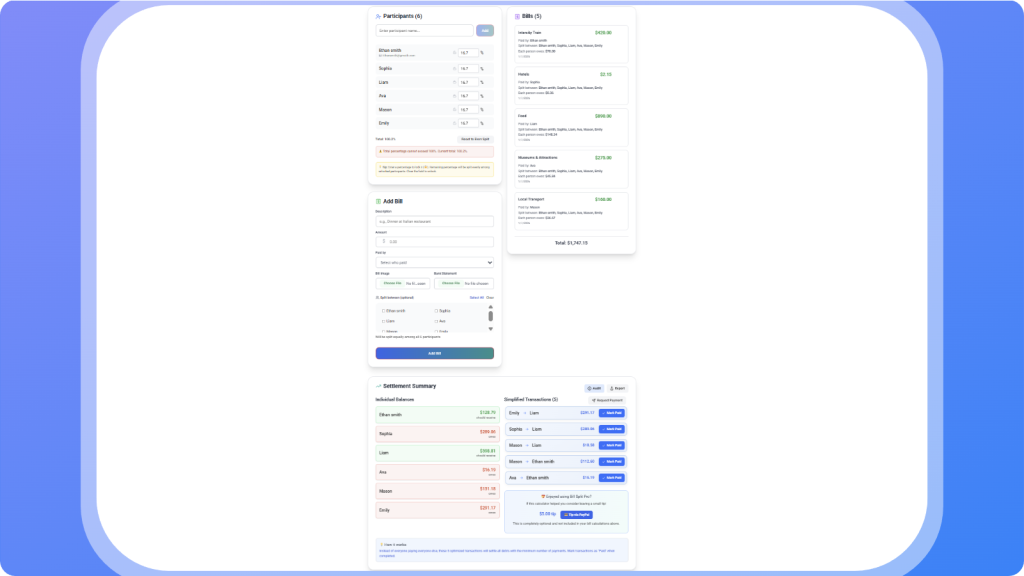
Tracking shared costs in one place, such as a simple bill split calculator, keeps everything visible and avoids follow-up messages after the party.
Last-minute changes are normal. Extra guests show up. Plans shift. Costs increase.
What matters is how those changes are handled. Agree in advance who can approve added spending and whether extra costs are shared or optional. Communicate changes immediately so no one is surprised later.
Real-time shared expense tracking helps everyone see updates as they happen. This keeps small changes from turning into arguments after the event.

Party expenses work best when money rules are agreed on before spending begins.
Clear expectations protect friendships and keep the focus on celebrating, not settling debts.
Most problems come from assumptions. A simple plan keeps the event fun and stress-free for everyone involved.
🎉
Track and split all party expenses transparently with Bill Split Pro. Focus on celebrating, not calculating.
