

Household bills add up quickly. Rent, utilities, internet, groceries, and subscriptions all compete for space in your budget.
How you split those costs depends on who you live with. A fair arrangement with a spouse may look very different from one with roommates. In many cases, fair does not automatically mean equal.
This article explains the main ways households divide bills and how to choose a system that feels balanced and sustainable.
"Household bills should reflect both usage and income. If everyone benefits equally and earns similarly, splitting 50-50 works well. If space, usage, or income differs a lot, adjusting the split keeps things balanced and avoids quiet resentment." - Martynas Baniulis
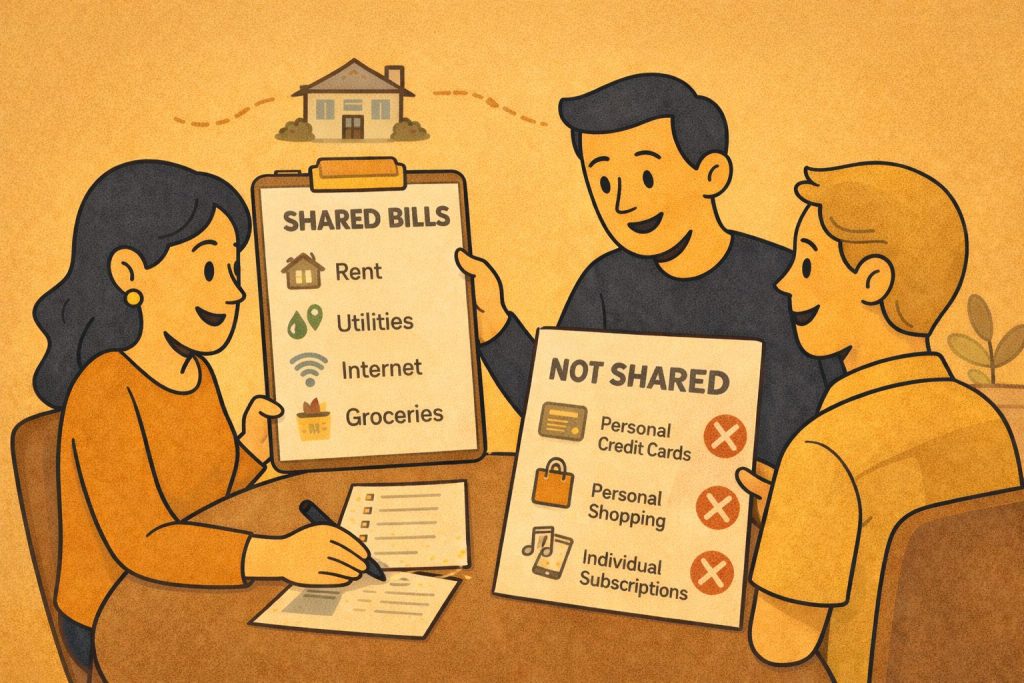
Before deciding how to split costs, identify which expenses count as shared.
As a general rule, if everyone benefits from the service, it can be treated as a shared expense.
✅Common household bills include:
• Rent or mortgage
• Insurance
• Utilities – gas, water, electricity
• Internet
• Phone plans (if shared)
• Streaming services
• Transportation or parking
• Groceries
Personal credit cards, individual subscriptions, and personal shopping usually stay separate.
Writing everything down first prevents arguments later.
Once shared expenses are defined, you need a structure for dividing them. Most households rely on one of three core models.
Equal splitting divides all shared costs evenly.
If rent is $2,400 and three roommates live there, each pays $800.
This approach works well when:
• Incomes are similar
• Bedrooms and amenities are comparable
• Everyone expects to pay a fixed share
• Simplicity is the priority
It is easy to manage and predictable month to month. The downside appears when income differences are large.
Income-based splitting adjusts contributions based on earning capacity.
If one partner earns 70 percent of the household income, they may cover 70 percent of the shared expenses.
This approach works best when:
• There is a noticeable income gap
• The household wants to maintain a certain standard of living
• One person would feel financial strain under a 50/50 split
Because income can change over time, this system requires occasional review.
In practice, many households do not stick strictly to one method. Instead, they apply different logic to different types of bills.
For example:
• Utilities may be split evenly while housing is income-based
• A larger bedroom may justify a slightly higher rent share
• A private parking spot may be paid entirely by the person who uses it
This structure allows adjustments where differences are obvious without overcomplicating every bill.
The right method depends on how your household actually functions, not on what sounds ideal in theory.
• Income differences
• Room size and access to amenities
• Usage patterns
• Long-term financial goals
• Personal comfort with shared accounts
f one person consistently feels stretched or another feels they are covering more than expected, the system likely needs adjustment.
The goal is balance that holds up over time.
Even a fair split can create tension if no one knows who paid what.
Practical habits make a difference:
• List every recurring bill
• Assign responsibility clearly
• Update amounts when costs increase
• Review totals periodically
Using a bill split calculator helps apply equal or proportional splits automatically and keeps balances visible to everyone involved.
When numbers are transparent, discussions stay practical.

Fair household bill splitting depends on context. Equal splits work for some homes. Income-based or hybrid methods work better for others.
Define shared expenses clearly. Choose a method that reflects real use and income. Revisit the system when circumstances change.
When expectations are visible and agreed upon, household finances feel manageable instead of stressful.
💪
Handle shared expenses clearly and fairly with Bill Split Pro. Keep balances accurate and avoid confusion from the start.
Clear & Fair
